
The Reverend Richard Sheepshanks and the Euphrates Expedition
Post by Dr Samantha Evans, Assistant Archivist
Towards the end of last year, I was given the task of cataloguing two banker’s boxes of early-nineteenth-century papers in the collections of the Royal Greenwich Observatory at Cambridge University Library (RGO 69): they were labelled ‘Sheepshanks papers’, and not much was known about them. They were accompanied by an unnumbered box list, prepared as part of the Laurie Cataloguing Project, before the RGO collection was transferred to Cambridge. The papers were gathered into unnumbered sections by paperclips (some of which had fallen out), and were not, or no longer, sitting in the boxes in the same order as the box list. Reconciling the box contents with the box list was the first challenge.
Richard Sheepshanks was born in 1794 in Leeds, the son of a cloth manufacturer. He was a student at Trinity College, Cambridge, from 1812, graduating with a BA in 1816, and was elected a fellow of Trinity in 1817. He studied law at Lincoln’s Inn from 1816, and was called to the bar in 1825, but did not practice. He was ordained in 1826 but did not serve in any clerical role. He was very well off. He devoted his life to scientific pursuits, especially astronomy. He was secretary of the Royal Astronomical Society from 1829 to 1831, and was elected a fellow of the Royal Society of London in 1830. He promoted the building of the Cambridge University Observatory and helped to devise its regulations, and was a member of the Board of Visitors at the Royal Observatory at Greenwich (this, and his scientific collaboration with the Observatory, probably explains why some of his papers ended up at Greenwich: other papers, including correspondence, are at the RAS). From 1824 to 1841 he lived in Woburn Place, London, then moved to Reading, where he died in 1855. He never married, but had a daughter, Eleanor Henry, with an Irish dancer; Eleanor Henry was later the mother of the painter Walter Sickert and the feminist Helena Swanwick. A crater on the moon is named Sheepshanks after Richard’s sister Anne, a benefactor of the RAS.
The bulk of the collection consisted of astronomical observations and calculations, which could conveniently be sorted by the place of observation, mostly keeping original paperclipped bundles intact.
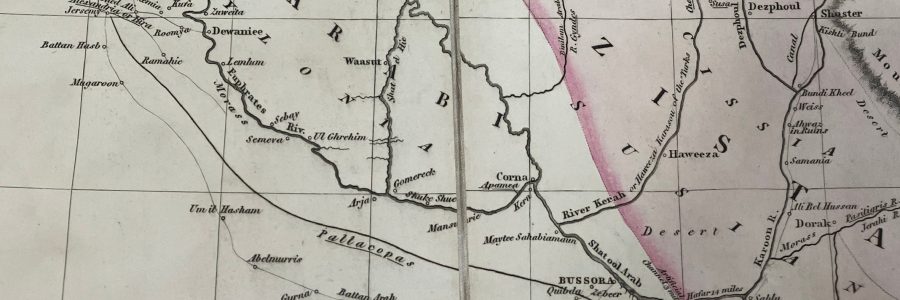
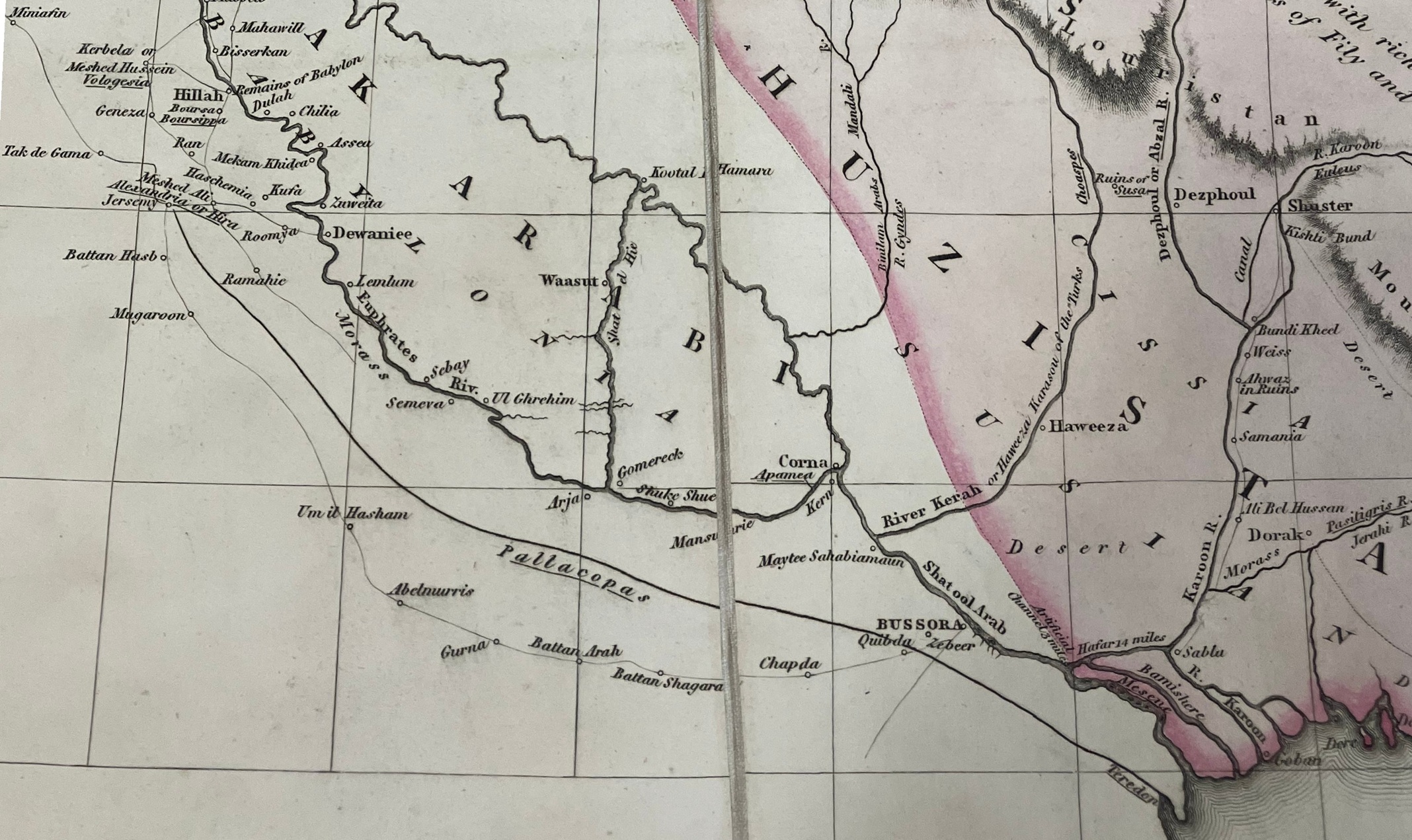
It was while trying to pin down the location of the frequently mentioned ‘Port William’ that I discovered Sheepshanks’s connection with the Euphrates Expedition. This Port William, named after King William IV, no longer exists and did not exist before the expedition, being an encampment on the Euphrates where two paddle steamers were assembled from parts transported from Britain, first by sea then, laboriously, by land from the Bay of Antioch.
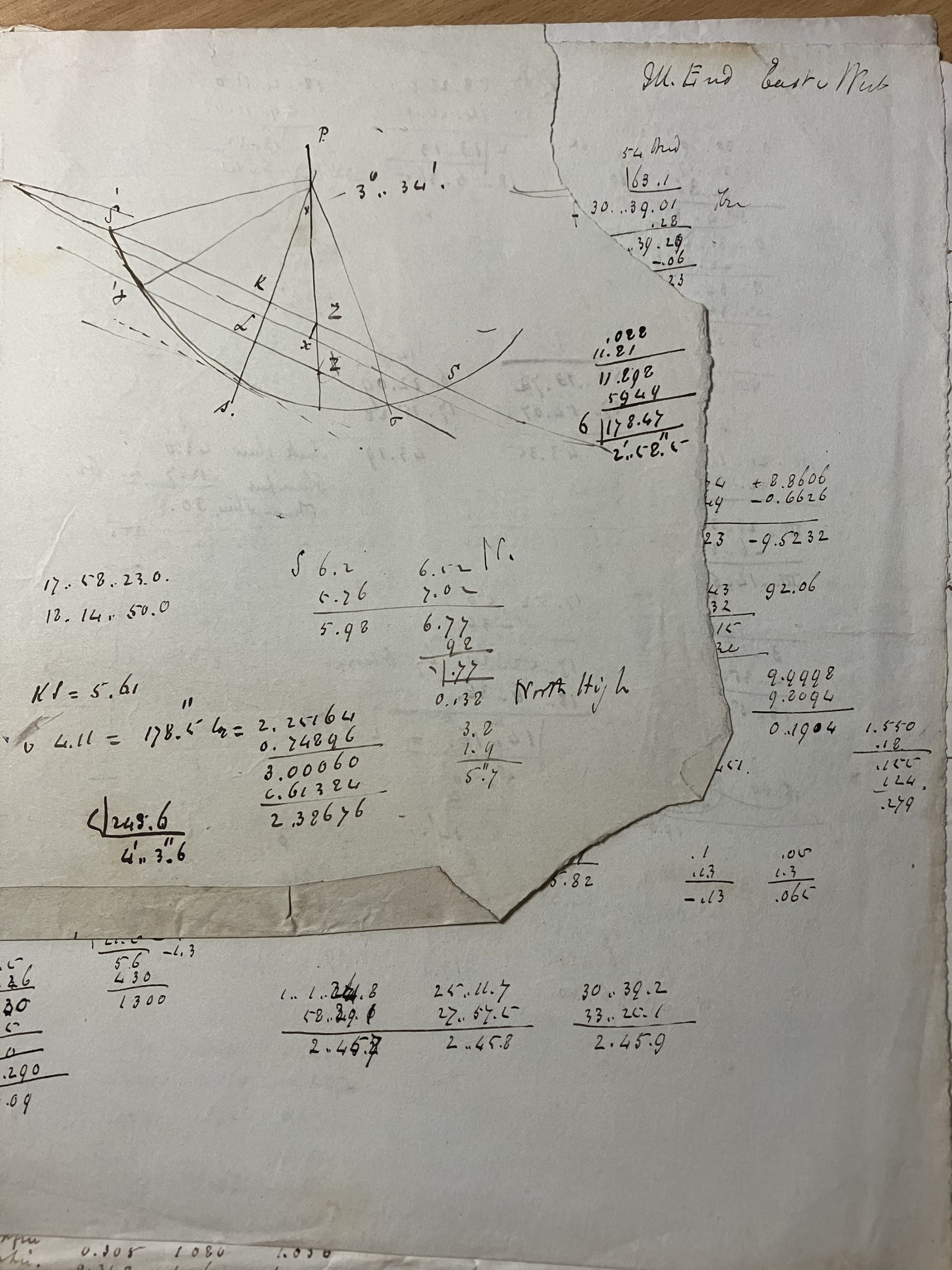
The expedition, documented most recently in John S. Guest’s The Euphrates Expedition, was intended to test the feasibility of running a fleet of paddle steamers up and down the Euphrates, and lasted from 1835 to 1837. It had the dual motivations of providing a route to India that avoided the long voyage around the Cape of Good Hope and discouraging further Russian expansion into the region; it also provided an opportunity to do some surveying. Surveying required astronomical observations, and these were undertaken by Lieutenant Hastings Fitz-Edward Murphy, who unfortunately died of a fever at Basra. Sheepshanks, who had persuaded Murphy to join the expedition, felt honour bound to take on the task of ‘reducing’ (processing) the raw observations (RGO 69/4/3). The largest group of calculations included in the Sheepshanks papers are his reductions of the observations from the Euphrates Expedition.
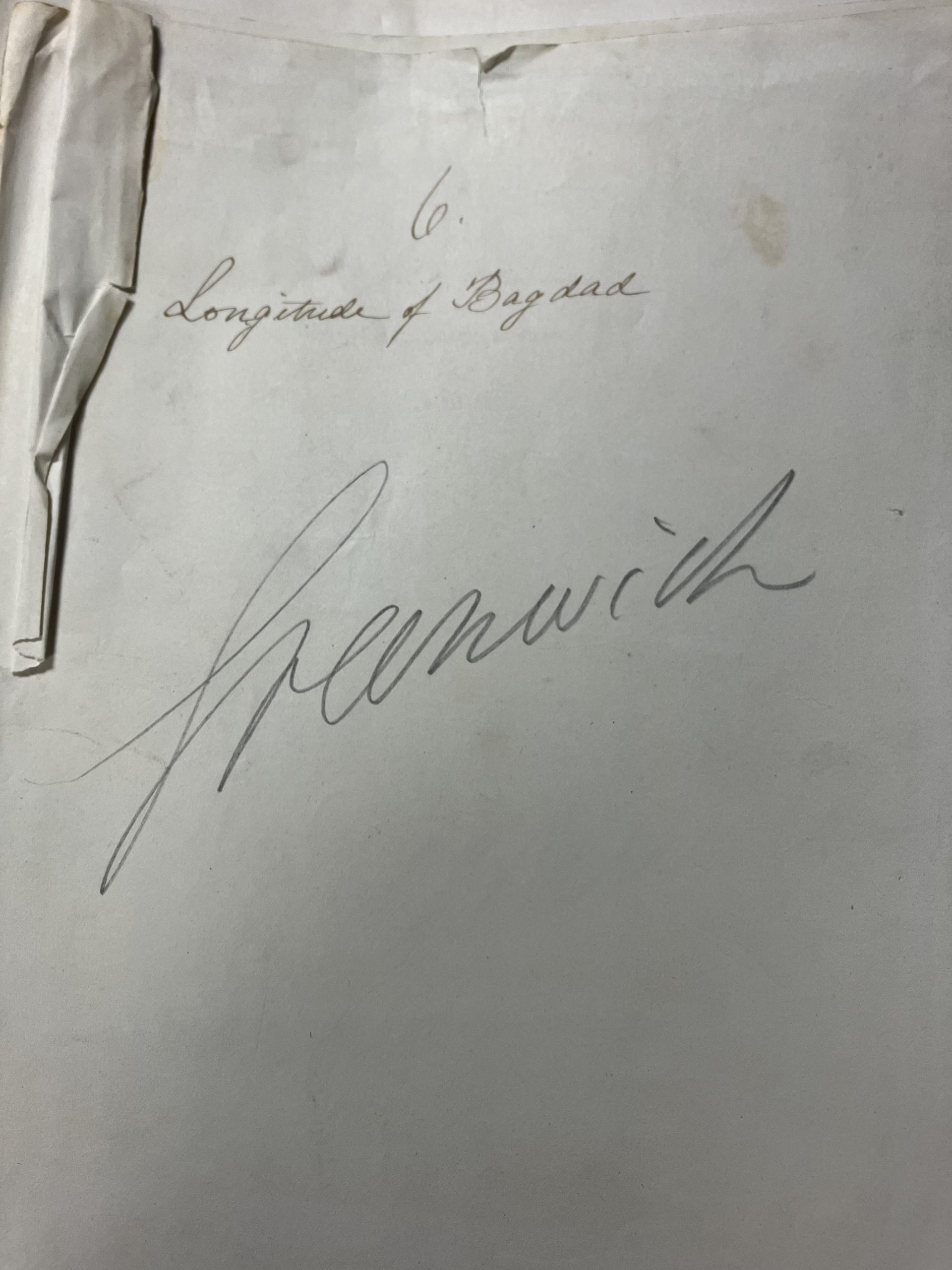
In general, these and the other calculations cite the date of the observations, but the calculations themselves are not dated. Since Sheepshanks sometimes worked on observations made long before he was born, the dates assigned in the box list therefore often seemed anomalous. However, Sheepshanks normally used paper with dated watermarks, which enabled me, by holding the paper up to my computer screen, to assign dates at the level of a particular year (or later). This also gave a clue to which observations were his own. If the watermark postdated the observations, he was probably working on observations that had been sent to him or that he had found in old records. If it pre-dated the observations, or was the same year, then these were probably his own observations, as is the case with a quantity of observations from Europe in 1839. In addition, these European observations were made on very thin blue paper rather than the usual cream notepaper; it was presumably more convenient for travelling. A stray title page with the heading ‘Observations on Tour 1839’ (RGO 69/12/2) bears out this interpretation. (The papers were evidently sent to Greenwich after Sheepshanks’s death in bundles with numbered title pages; a key to them survives (RGO 69/12/1), but most of them had been detached from their contents at some point, and occasionally reattached to unrelated contents.)
Sheepshanks’s use of paper was interesting in other ways. He evidently bought large sheets of light-weight cream-coloured paper and folded them in half first horizontally then vertically to make a kind of booklet, slitting the horizontal folds as necessary to open up the pages. Sometimes he sewed these little gatherings into a larger booklet or held loose sheets together with tiny pins. He rarely wrote on both sides of the paper. Paper this old, even when it is nothing fancy, is a treat to handle. Being non-acidic, it is well preserved except where the edges have been exposed to dust and dirt. Sheepshanks tended to order from Whatman, a maker of famously high-quality paper. The collection also includes a small amount of correspondence, draft papers, and notebooks.
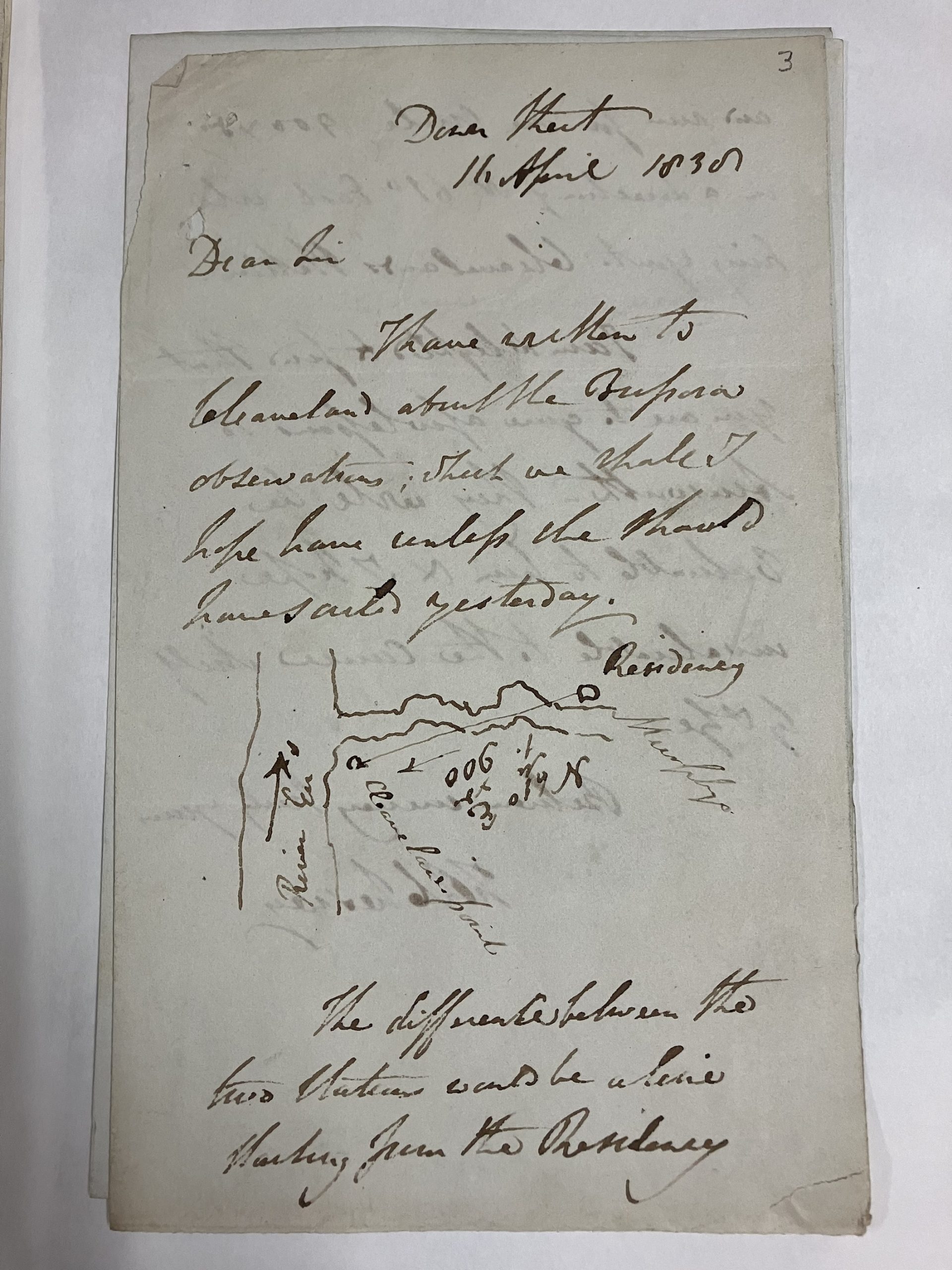
This letter is from Col. Francis Rawdon Chesney, the leader of the Euphrates Expedition. The expedition had a limited afterlife in the form of a mail service on the Tigris between Basra and Baghdad. The East India Company funded it having expressed the strong desire that Chesney not be involved in any way (Guest 1992, pp. 140, 145). Chesney had been an enthusiast for the expedition but was felt to lack the diplomatic skills and experience with steam navigation needed to make a success of it. One paddle steamer had been wrecked, with some loss of life, and the expedition had been dogged by illness and practical obstacles. In his Expedition for the Survey of the Rivers Euphrates and Tigris 1: xix, Chesney expressed his indebtedness to Sheepshanks for his work on Murphy’s observations and for his ‘triangulations and other materials’ for the maps.
The Richard Sheepshanks Papers are available for consultation in the Special Collections Reading Room. The online catalogue is available here.
With thanks to Dr Emma Saunders and Mr Adam Perkins, current and former curators of the Royal Greenwich Observatory Archives.
Sources
Francis Rawdon Chesney, Expedition for the Survey of the Rivers Euphrates and Tigris. 2 vols. London: Longman, Brown, Green, and Longmans. 1850.
John S. Guest, The Euphrates Expedition. London and New York: Kegan Paul International. 1992.
Anna Gruetzner Robins, ed., Walter Sickert: the complete writings on art. Oxford: Oxford University Press. 2002.
Obituary of Richard Sheepshanks, Monthly Notices of the Royal Astronomical Society 16 (1856): 90-97.