
Telling tales: manuscripts, scribes, stories
A guest blog post from Linda van Rheinberg, student at Heinrich Heine University, Düsseldorf
Manuscripts contain tales and stories about the past, describing and documenting medieval life and time. When we read between the lines that have been written on the parchment, we can also find stories about the people who produced, read, and cared for these books. These stories can be found in the notes scribbled in the margins, in the spills and damage on the parchment, and in the handwriting of the scribes. When I work with manuscripts, I love finding these snippets and clues about medieval life, and putting together all these little puzzle pieces; they make me feel connected to these people who have lived their lives long before me.
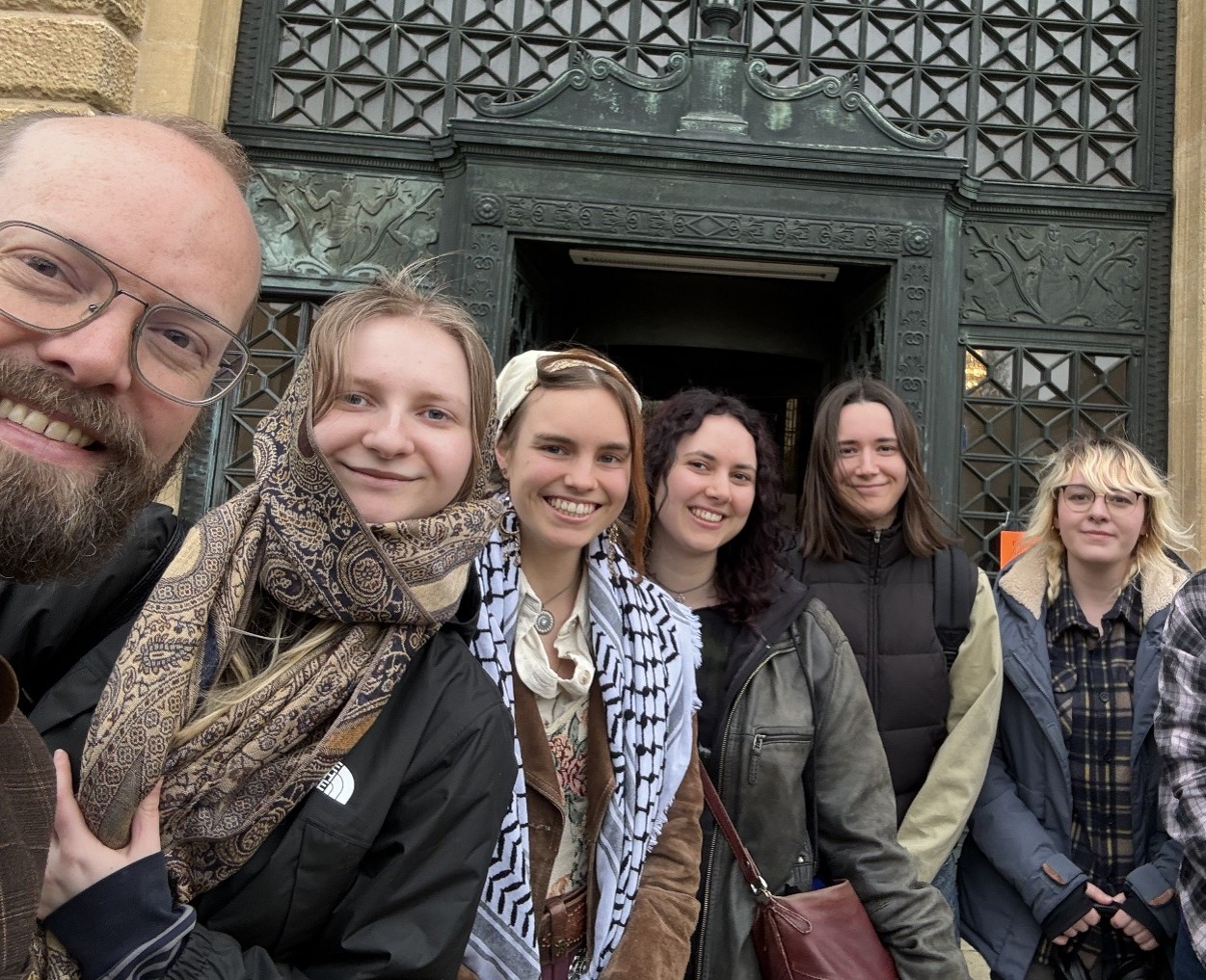
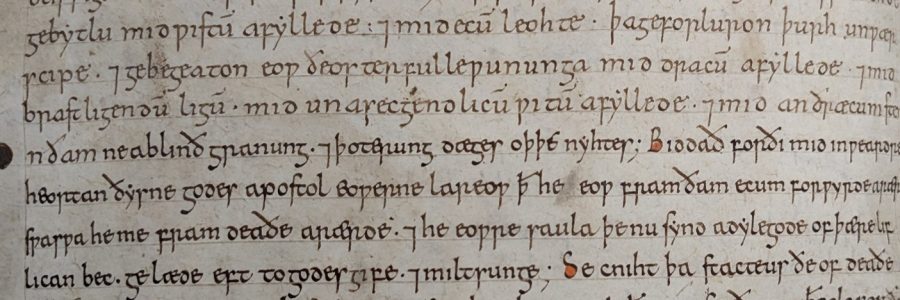
To discover these stories, I travelled to Cambridge University Library in early March as part of my course on Medieval English Literature and Historical Linguistics at Heinrich Heine University in Düsseldorf, Germany. We examined several different manuscripts from the perspective of palaeography and codicology: that is, the handwriting and the physical characteristics of a manuscript. One story that I was able to piece together and found very exciting was about the relationship between two scribes. It is hidden within the pages of Cambridge, University Library, MS Gg.3.28 – a manuscript containing homilies and catholic sermons by Ælfric of Eynsham (d. c. 1010).
The manuscript was written by two scribes: the main scribe – who I will be calling Scribe A – and a minor scribe – Scribe B. Scribe A wrote the majority of the manuscript, and Scribe B did only shorter stints throughout. This situation is itself noteworthy: it means that Scribe A planned the writing process, and the spacing and sizing of the parchment, and Scribe B had to adapt and conform their handwriting to it. The first time Scribe B takes over the writing, they seem to struggle with this, since their handwriting is smaller and more narrow than that of Scribe A. We can also observe that Scribe B manages slowly to assimilate the module of their writing with that of Scribe A and, by the time of their last contribution, has managed to make the height and width of their letters identical to those written by Scribe A.
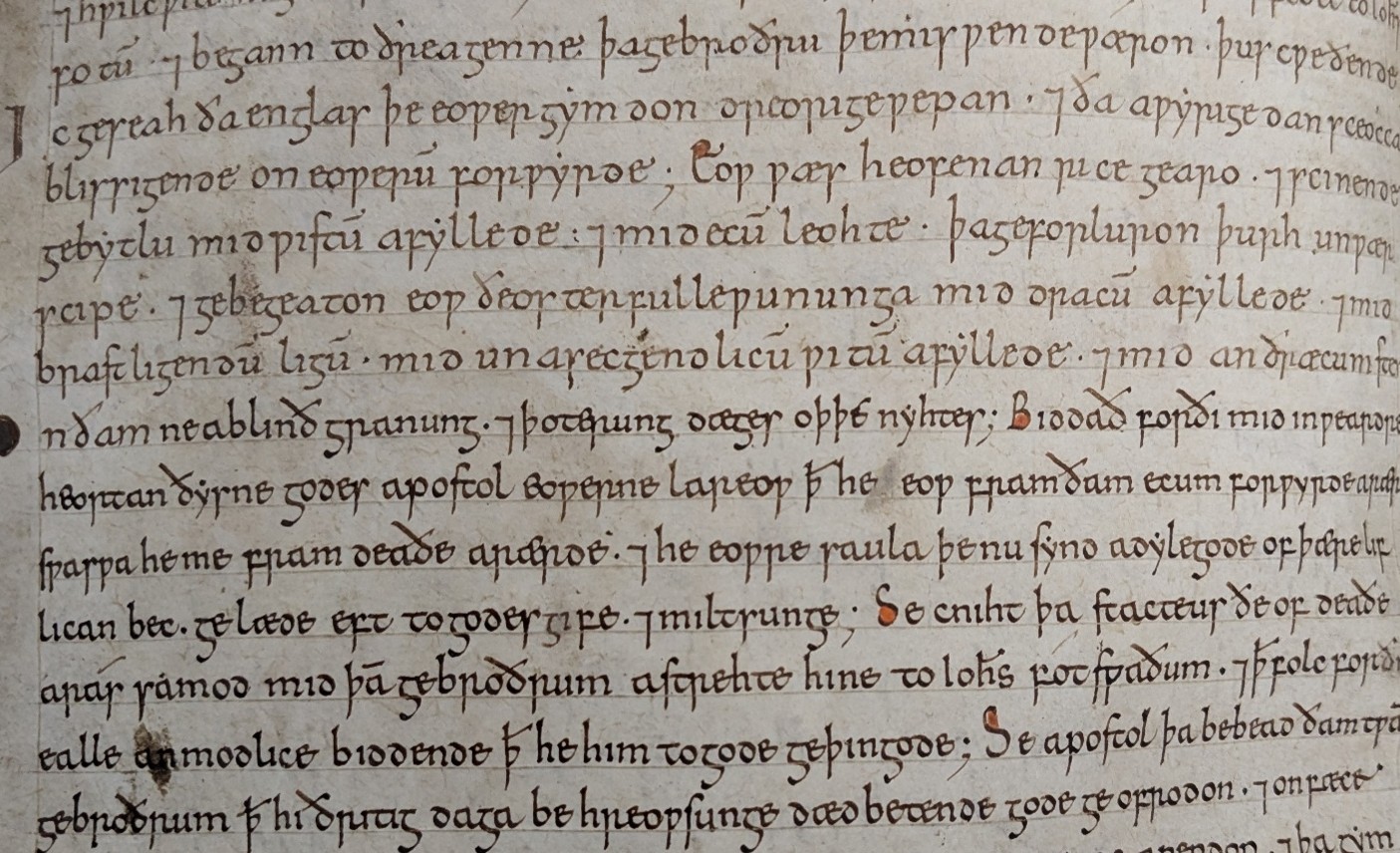
Interestingly, there are many more mistakes and corrections in the parts written by Scribe B than those of their co-worker. Upon close examination, the handwriting of Scribe A is recognisable in some of these corrections: words or letters are scratched out, replaced, and corrected. This revision is a one-sided relationship between Scribe A and Scribe B: Scribe B does not correct the errors of Scribe A; Scribe A does that themselves. When I noticed this phenomenon, I got really excited, since it tells us a clear story about the relationship between the two scribes working together a thousand years ago. The many mistakes and corrections in Scribe B’s sections, as well as the relatively small amount of writing done by them, in comparison to Scribe A’s major contribution, indicate a teacher-student relationship: Scribe A is teaching Scribe B the craft of writing.
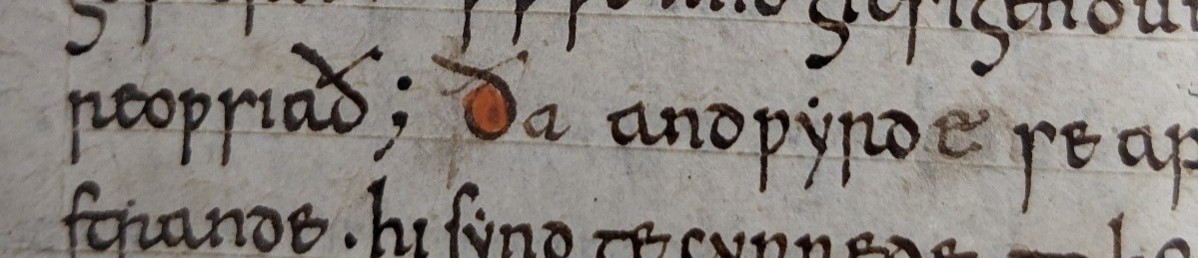
Over the course of the manuscript, Scribe B appears to improve their writing skills: not only do they adapt and conform their handwriting to the spacing and sizing of Scribe A’s letterforms, but they make fewer mistakes. This transformation of Scribe B’s handwriting was exhilarating to discover: to be able to see the confidence and precision they developed throughout their training on the parchment allowed me to feel connected to the scribes and their stories and to identify myself – as a fellow student – with their learning process.
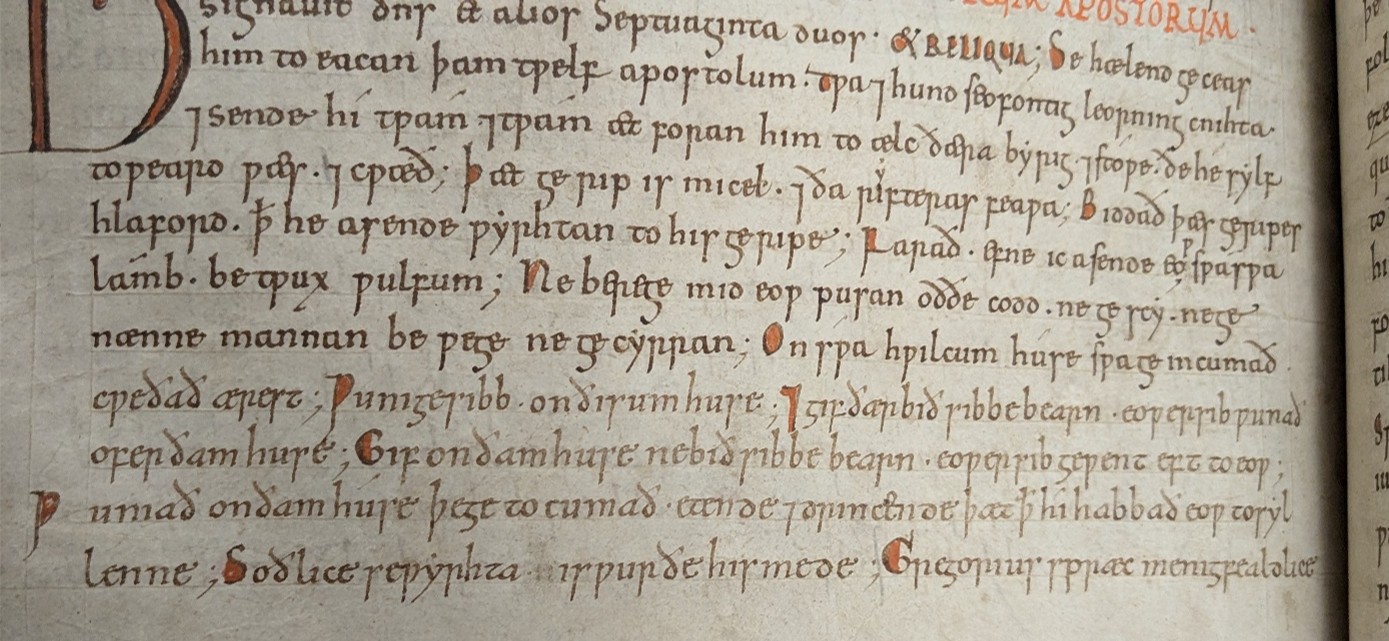
Another thing I observed was the position and location of the scribal exchanges. Many of them occur in the middle of sentences: one scribe starts a sentence and the other ends it. Therefore, the two scribes likely occupied the same physical space, perhaps a scriptorium or another place where manuscript production was conducted. While the sites of scribal change might seem random and arbitrary to us, they made sense to them: they were probably working together closely, communicating about their work and its challenges.

We can explore a further story through the dissimilar letterforms used by the two scribes. Both write in English Vernacular Minuscule script, but Scribe A’s letters are more rounded, and Scribe B’s more square. We can also see that Scribe B alternates between three different variants for the letter s: the ‘high’, ‘low’, and ’round’ forms all occur frequently in their writing. Scribe A, however, only utilises the ‘low’ and the ‘high’ s, apart from when it is in ligature with t. Likewise with the letter æ, Scribe B writes a ‘high’ e – as is common in Square Miniscule (an earlier script), the e is taller than the a – whereas Scribe A writes both letter-components with equal height. Many such minor dissimilarities are observable in the handwriting of these scribes. When I noticed saw these differences, I was delighted! Not only do they show that Scribe B appears to have learned their letters differently than Scribe A, but their overall style is usually described as an older script style. And given that Scribe B is the student in the scribal relationship, this is a very interesting discovery. But what might it tell us?
Scribe B may have learned their letter forms from someone who had a similar style: considering the stark differences between the styles of Scribe A and B, it does not seem likely that Scribe A initially taught Scribe B their letter forms. As Scribe B also uses letter variants differently, it is probable that they started their training in manuscript writing with someone else. Perhaps Scribe A was teaching Scribe B when they were already relatively far along in their training. Scribe B may have already learned to form letter shapes on wax tablets and this was their first major experience with ink and parchment.
Putting together all of these clues to figure out the story of the scribes is always a highlight when working with manuscripts. This kind of excitement is something I have not found anywhere else; the connection I feel to these scribes and the story that I am able to unpack about their work and experiences transcends the centuries of time between us and reminds me of the struggles and advances within my own studies as a fellow student.
That was fascinating, excellent work!