
Inside Darwin’s bookshelves: a project to catalogue his personal library
Post by Alex Cuadrado, Darwin Library Cataloguer
Charles Darwin changed how we see our place in nature, but how did he build the theories that shook the world? Part of the answer lies in the pages he turned every day. We are excited to announce a new project to fully catalogue Darwin’s personal library so that it is discoverable through iDiscover. Preserved across Cambridge University Library and the Down House, Darwin’s home in Kent, this incredible archive includes his personal books, scientific offprints, and full journal sets.
The Darwin Library is part of the Darwin Archive, a collection of Charles Darwin’s working and family papers that Cambridge University Library and Archives (CULA) has been collecting with the support of the Darwin family since the 1940s. Much of the book collection came through Darwin’s son Francis, who worked as Darwin’s assistant towards the end of his life; other works came from Charles Darwin’s wife Emma’s estate. Darwin’s descendants divided his library between ’CULA and Down House, with the intention of placing heavily annotated and rare books in Cambridge so that they can be conveniently consulted by scholars.
The primary goal of this project is to consistently group, inventory, and catalogue the entire collection. While these items have long been part of our Special Collections, this work ensures that everyone, from global researchers to Darwin enthusiasts, can find exactly what they are looking for through a unified library system. The project has already concluded the cataloguing of Darwin’s book collection, consisting of around 800 books. The collection contains volumes in several languages in addition to English: German, French, Latin, Italian, and Spanish, including copies of Darwin’s own published works translated into French and German. Many of these very volumes travelled with him on the HMS Beagle, serving as silent partners in his transformation from a curious student of natural philosophy into one of the century’s most influential scientists.
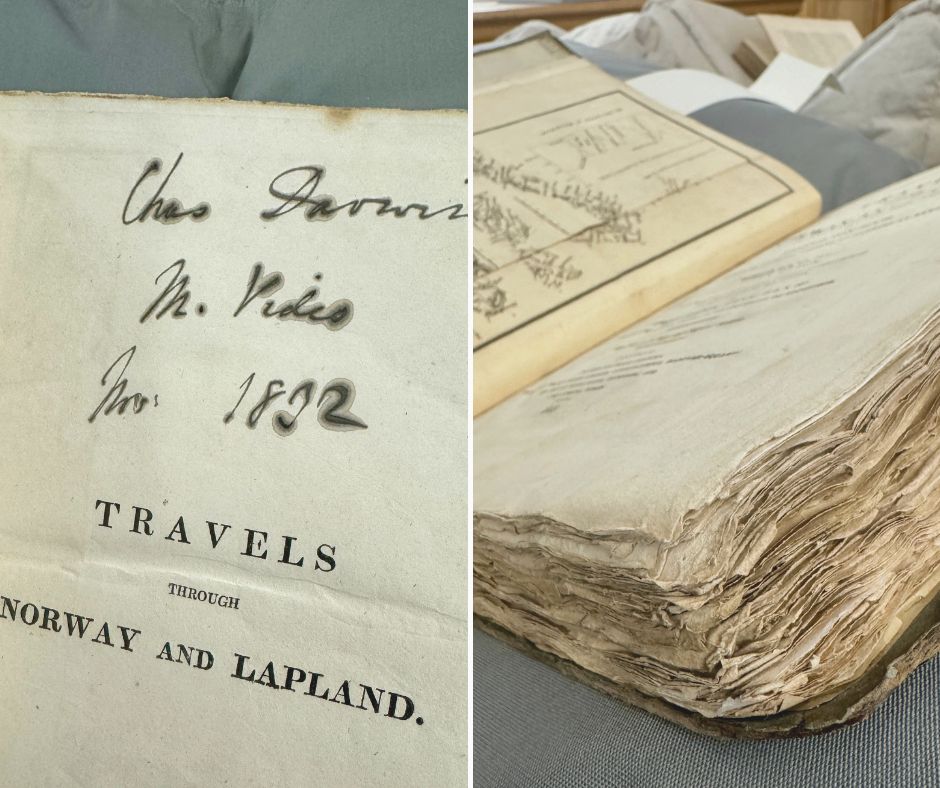
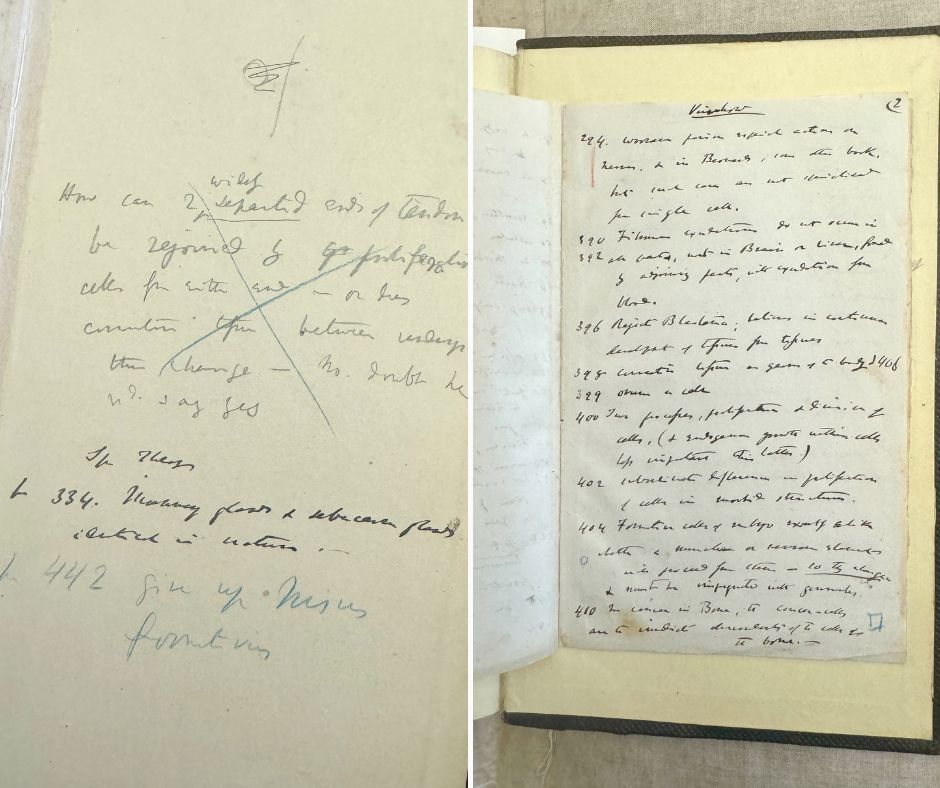
One of the most valuable aspects of this project is the insight it provides into Darwin’s working mind. We know from his letters and notebooks that he was a prolific writer, but his books reinforce the idea that he was a tireless annotator. He did not simply read; he entered into a dialogue with the author. His books are filled with professional scientific comments and personal thoughts recorded as he read. Darwin’s annotations often show an appreciation and respect for his contemporaries, but we have also enjoyed discovering his “grumpy” side through comments such as “Rubbish!”, “Not for me”, or “Very poor & useless Book.”
As was common in the 19th century, Darwin used the margins to write comments and underline relevant text. He often used vertical cross-markings in the margins to highlight full paragraphs. Even more interesting is how he organized his research: he frequently recorded his thoughts on separate slips of paper of different types, normally blue in colour, and then wrote the page number to link the comment back to the book. Looking closely at his notes in Rudolf Virchow’s Cellular Pathology (DAR.LIB.642), you can see where he drew distinct circles and squares in blue. Can you guess what those coloured marking symbols might mean?
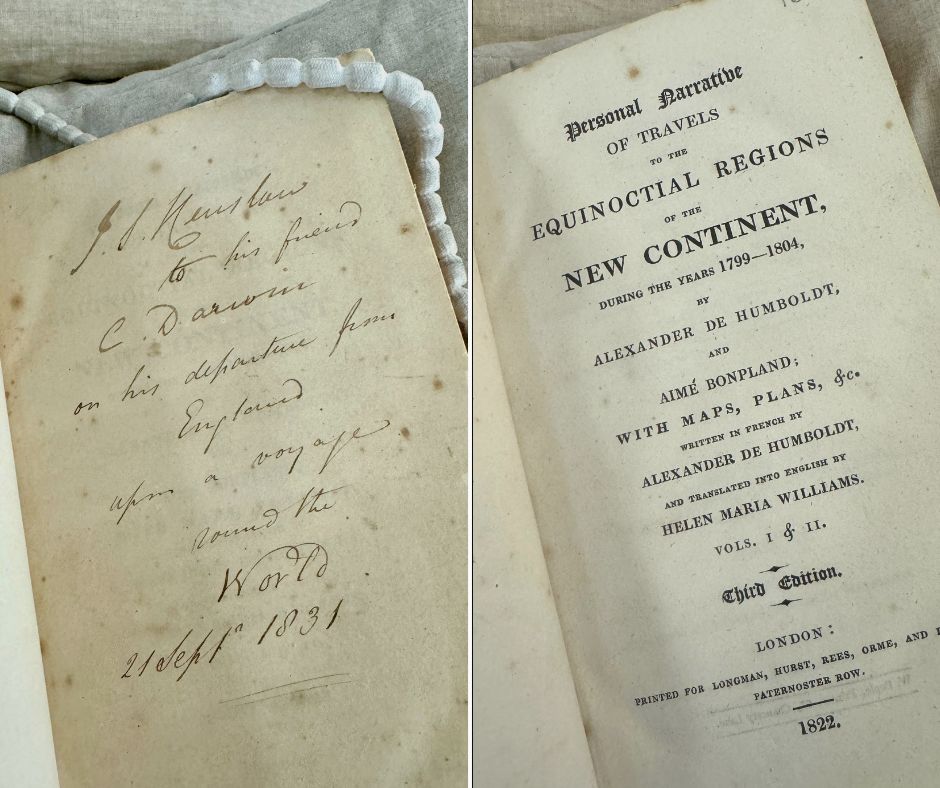
The collection is a record of 19th-century scientific friendship. It features presentation copies and inscriptions from the most important minds of the era, including Charles Lyell, Robert FitzRoy, T. R. Malthus, and Joseph Hooker. One of the most significant items is the copy of Alexander von Humboldt’s Personal Narrative given to Darwin by his mentor, John Stevens Henslow, just before the Beagle set sail.
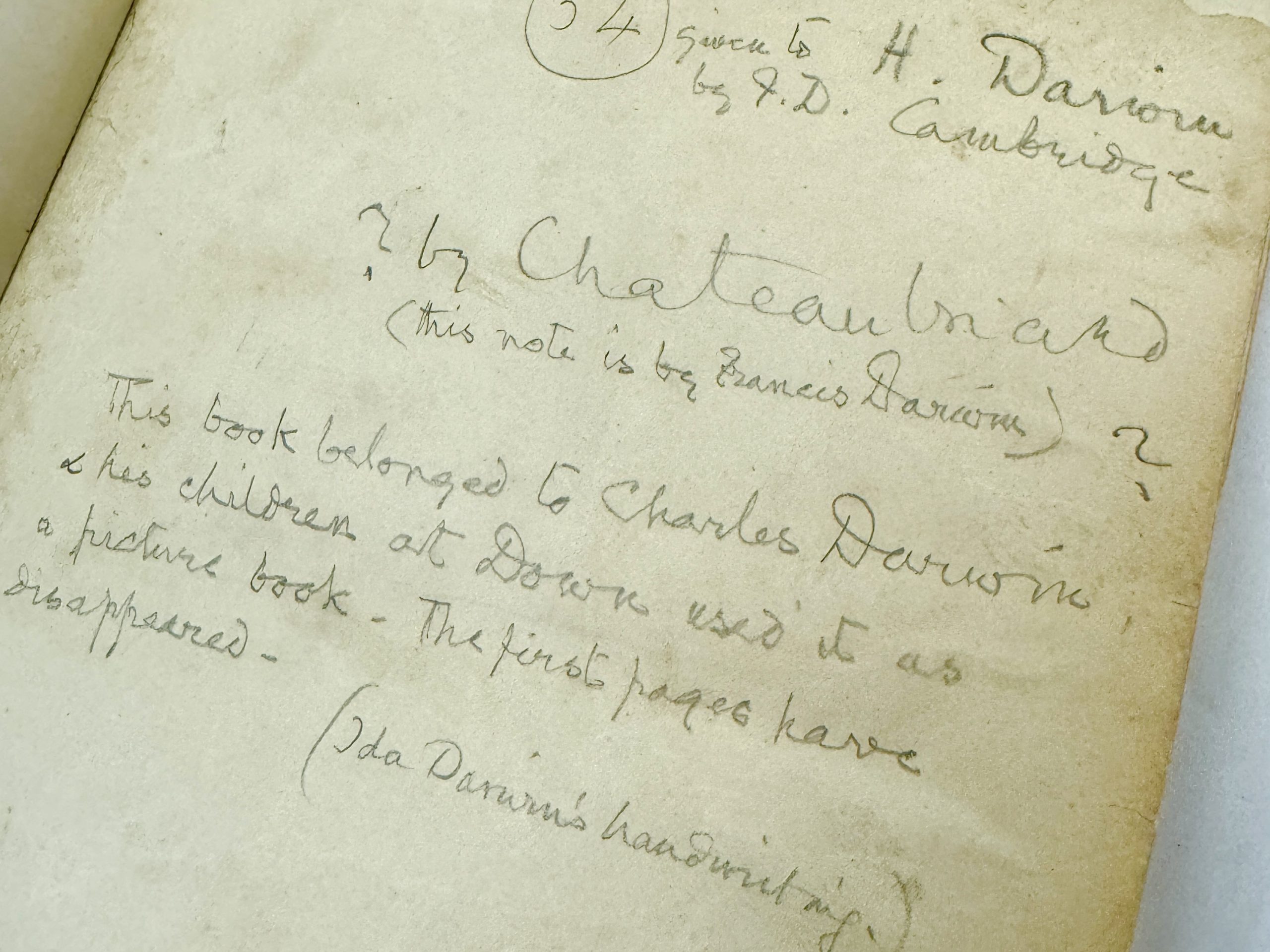
Beyond the scientific story, the collection preserves the intimate history of the Darwin family. Many books passed through several generations and bear signatures, annotations, and notes that document their journey. One example, DAR.LIB.783, contains a layered handwritten record of family life at Down House, noting that Darwin’s children later used his compiled collection of plates and maps as a personal picture book. With later inscriptions by his son Francis Darwin and daughter-in-law Ida Darwin identifying the book’s history, the volume becomes a rare material witness to the domestic and familial world that surrounded the scientist.
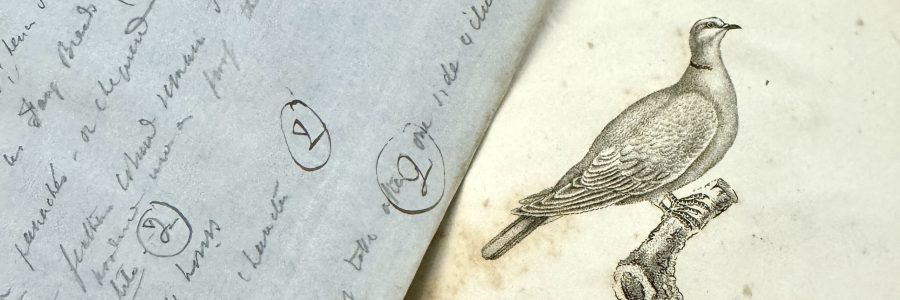
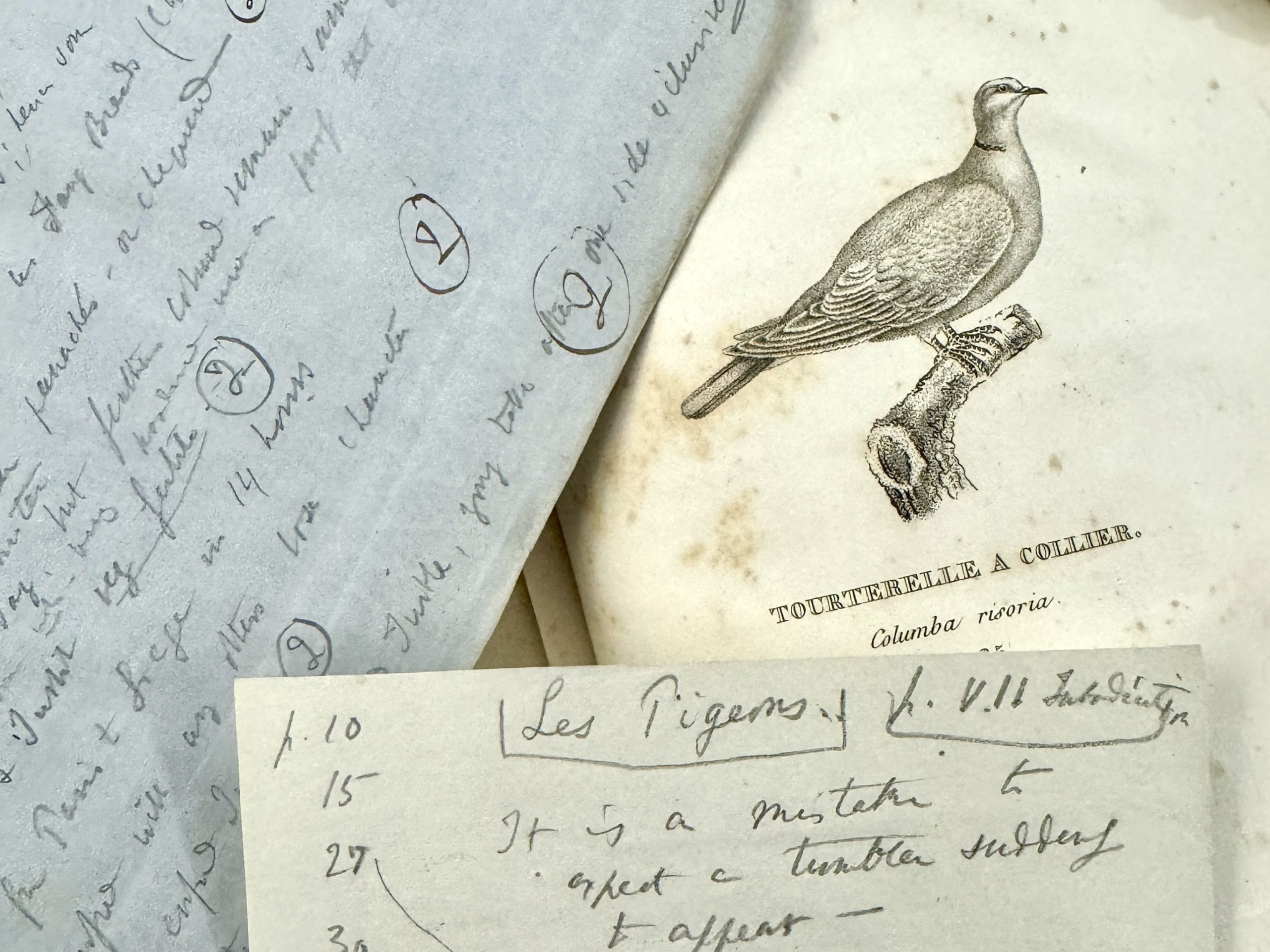
The collection is also a treasure trove of Victorian material culture. We are documenting the “tickets” (small labels from binders and booksellers), stamps, cards, and all sorts of ephemeral items found within the pages. Many volumes also contain exquisite engravings and hand-coloured illustrations of animals that often served as vital evidence for Darwin’s experiments. DAR.LIB.48, a French monograph on domestic pigeons, is a prime example; its charming ornithological plates are preserved alongside the very slips of paper Darwin used to record his findings.
Because Darwin was such a prolific annotator, we are not transcribing every marginal note. Instead, each catalogue record acts as a map, indicating where annotations appear and how they relate to the text. All personal dedications and presentation inscriptions are fully transcribed, and when possible, records include links to digitised copies available through the Biodiversity Heritage Library.
Ultimately, we hope this project will provide a lasting resource for scholarship and discovery. You do not need to wait for the project’s completion to begin exploring; simply search the classmark DAR.LIB. in iDiscover to browse the books already catalogued.
As we continue to add Darwin’s pamphlets and journals in the coming months, we look forward to sharing more from this living archive, offering fresh insights to everyone seeking to understand the history of science and the natural world.