
Bookers, sugar and Guyana
Bookers Cash and Carry, a subsidiary of Tesco PLC, is one of the largest wholesale distributors of food and drink in the United Kingdom with close to 200 branches nationwide. The Booker Prize for Fiction, established in 1969, was sponsored by Booker, McConnell Ltd. until 2001 and still retains the name Booker to this day.[1] However, with the notable exception of the first three chapters of Judy Slinn and Jennifer Tanburn’s corporate history, Bookers’ 19th century origins in British Guiana [Guyana] are obscure.[2] The Booker Group website and Wikipedia entry, for example, make little, if any, reference to the company’s origins, their role as agents, managers and attorneys in the period of enslavement and subsequent position as large-scale sugar plantation owners post-emancipation. A collection of research material accumulated by John Platt, recently donated to Cambridge University Library, has now been catalogued and is available to researchers in the Special Collections Reading Room.[3]
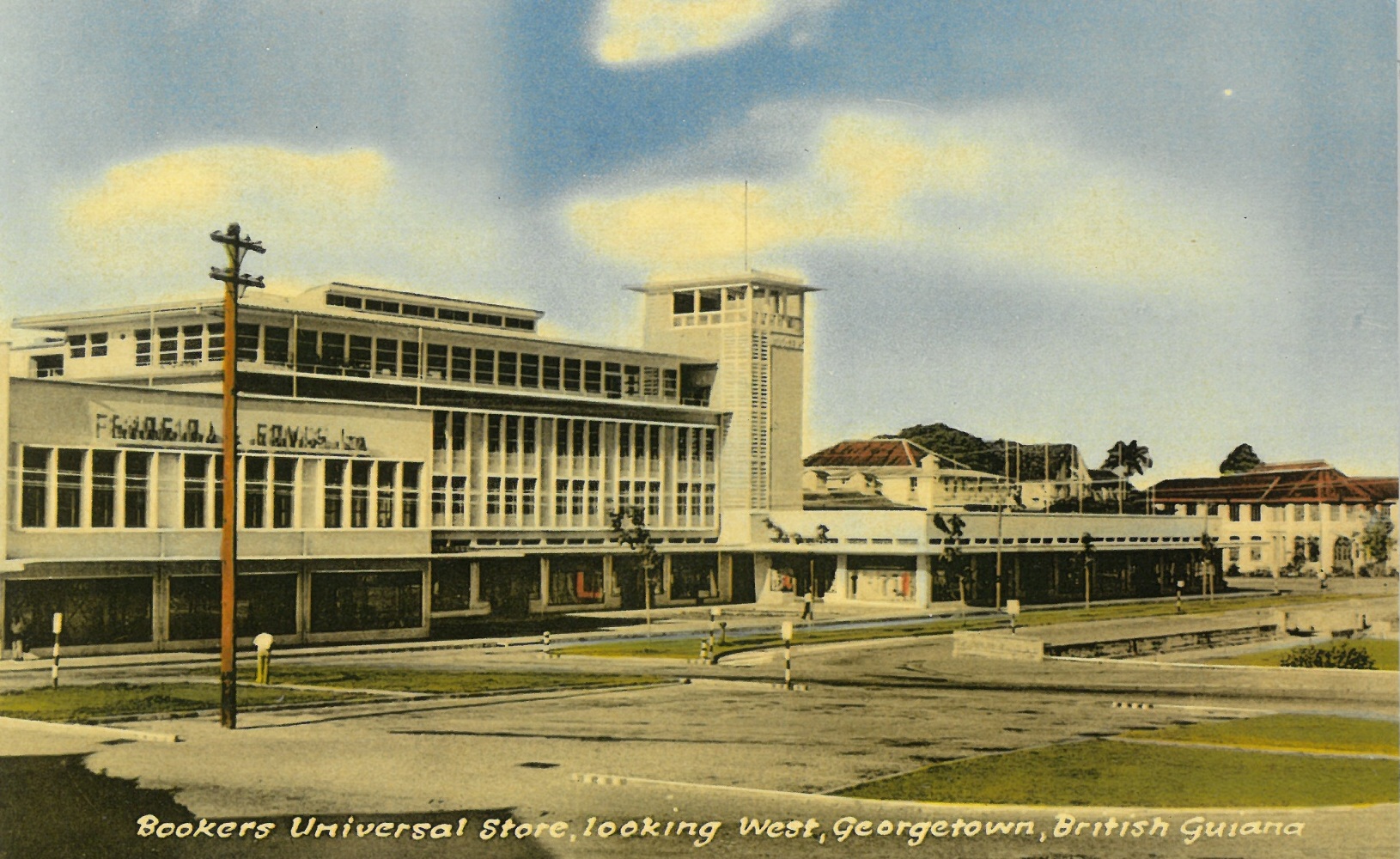
Original sources on the company’s early years are scarce, particularly for the period between 1815 when Josias Booker first travelled to Demerara and 1834 when his brothers, George and Richard, established a merchant house in Georgetown. Most company records were lost in successive fires in Georgetown in 1864, 1945 and 1962, while the London and Liverpool offices of Bookers Bros, McConnell and Co. Ltd. were destroyed in the Second World War. Two early 20th century attempts to produce a company history covering the formative years were also thought to have been lost in the bombing. The Platt collection sheds light on the complex early trajectory of the company, the role of Josias Booker and his brothers in Demerara and Liverpool, the establishment of shipping lines, and the exponential growth of the company until its merger with John McConnell & Co. Ltd. in 1900.
John Platt (1938-2025) had a lifelong interest in Guyana, having first visited in July 1958 while undertaking a two-year tour of duty with the Royal Navy in the Caribbean. During that initial visit, Platt visited a sugar estate, Diamond, on the east bank of the Demerara River. Platt subsequently joined Bookers in Georgetown at the beginning of 1964 on a two-year contract. In spite of the political unrest in Guyana in the years leading up to independence in 1966, he was able to visit a number of the Booker sugar estates including Blairmont and Enmore, and also carried out research in the Deeds Registry and at the Royal Agricultural and Commercial Society’s Library in Georgetown.
In the course of the next five decades, Platt continued to pursue his research in the UK when opportunities arose. A series of correspondence from the 1960s through to 2015 preserved in the archive charts his research progress. The archive includes research material accumulated by Miss Gladys Hamer (1887-1964), a secretary in the Liverpool Office of Booker Bros and a keen amateur historian. Platt also actively sought out and bought relevant material from private collectors and booksellers. The resulting archive is a well organised corpus of original 19th century documents, research notes and transcripts, secondary source material, photographs and illustrations, and Platt’s unpublished draft history titled ‘Booker Bros & Company, Demerara: Origins and Growth’.[4] This final draft, the product of a lifetime’s work and passion, dates to 2015. Platt seemingly did not pursue publication and it was quite by chance that the draft was located on his hard drive after his death in 2025.
Among the original documents are disparate 19th century office papers providing a brief glimpse into the growth of the company’s operations, and documents relating to the estate of William Booker (1796-1839) and Samuel Booker (1833-1879), as well as material relating to other planters, merchants and enslavers, including John Dalgleish Paterson (1780-1842), Quintin Hogg (1845-1903), William Russell (1827-1888), and others associated with Sandbach, Tinne & Co. The overall picture is a complex web of connections, both personal and professional, family and business, among the early British settlers in Guyana.
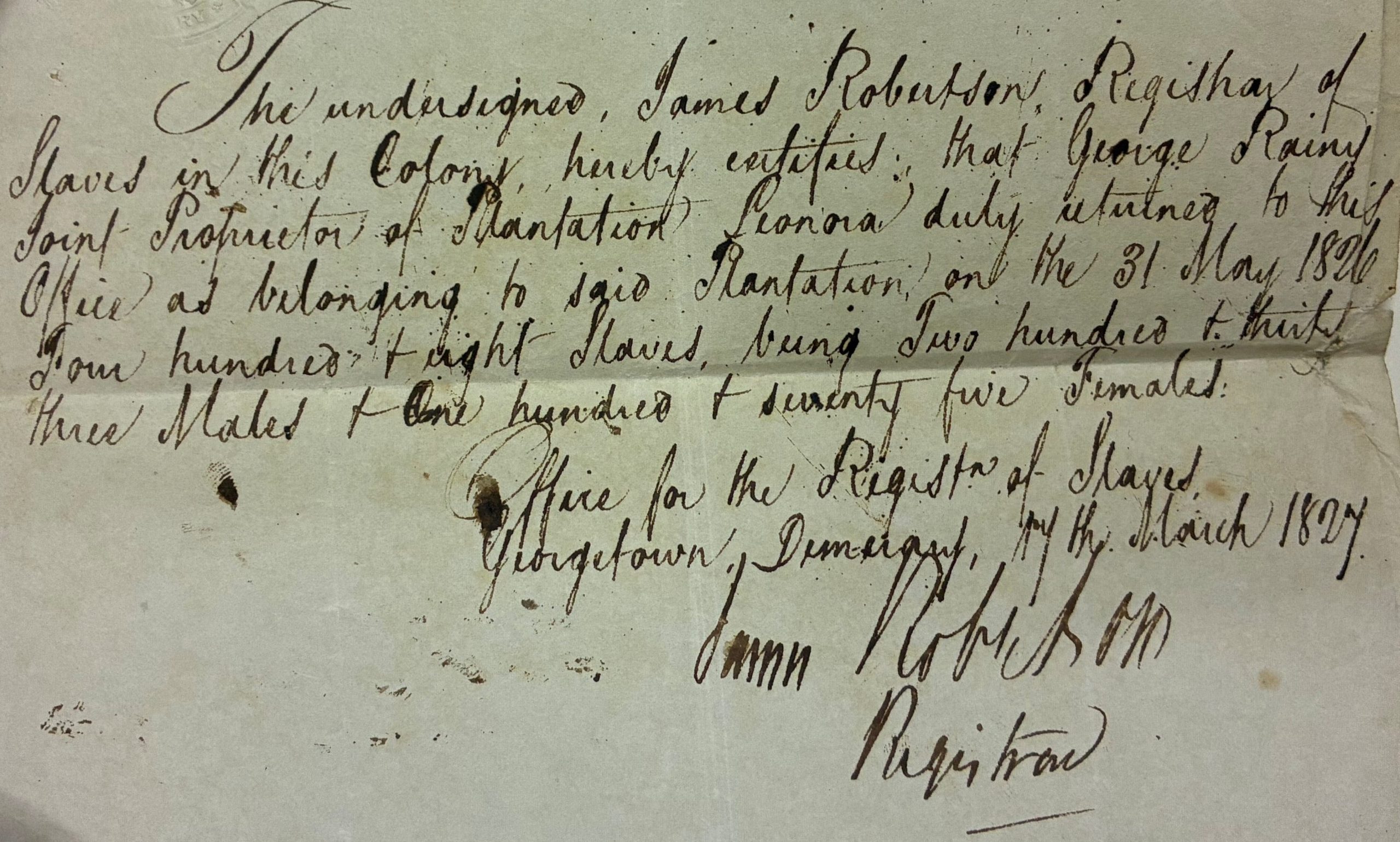
One of the most significant documents from this section is a ‘slave return’ for Plantation Leonora, then under the joint proprietorship of Sandbach, Tinne & Co. [5] The document is signed by James Robertson, Registrar of Slaves in Demerara, in May 1826 and attests that George Rainy, joint proprietor, owned 408 enslaved people (233 males and 175 females).[6]
Other documents reflect on the quality of rum samples distilled by John McConnell in 1875, with a report by the chemist John Stenhouse, as Booker Bros diversified into the rum trade. Other papers address the risks posed by shoaling at the entrance to Demerara Harbour; to keep pace with the sugar trade, ever larger ships needed to access the harbour.
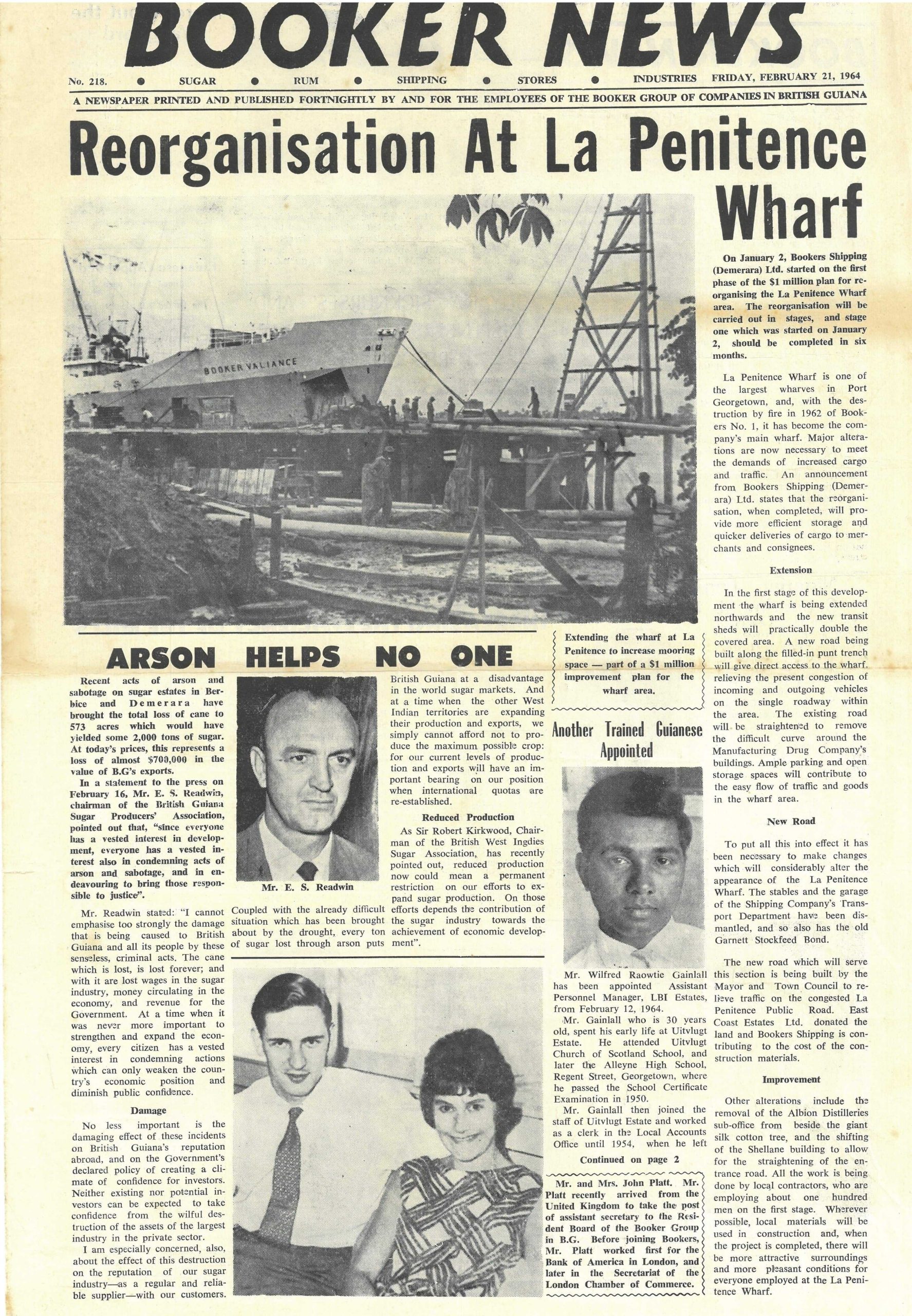
Platt dedicated considerable effort to tracing and documenting all sugar estates associated with Booker Bros. A chronological table collating this data is included in the final draft. Alongside this, Platt annotated two maps to show the locations of almost all the individual plantations around Mahaica Creek and the Demerara River. Among the secondary sources is a valuable collection of Booker’s in-house publications including annual reviews and accounts from the 1960s, a run of Booker News (the newspaper for Booker employees in Guyana), a 1919 guide to British Guiana and publications on the sugar industry. There are also a series of photographs, postcards and illustrations, relating to Bookers and to Guyana more broadly.
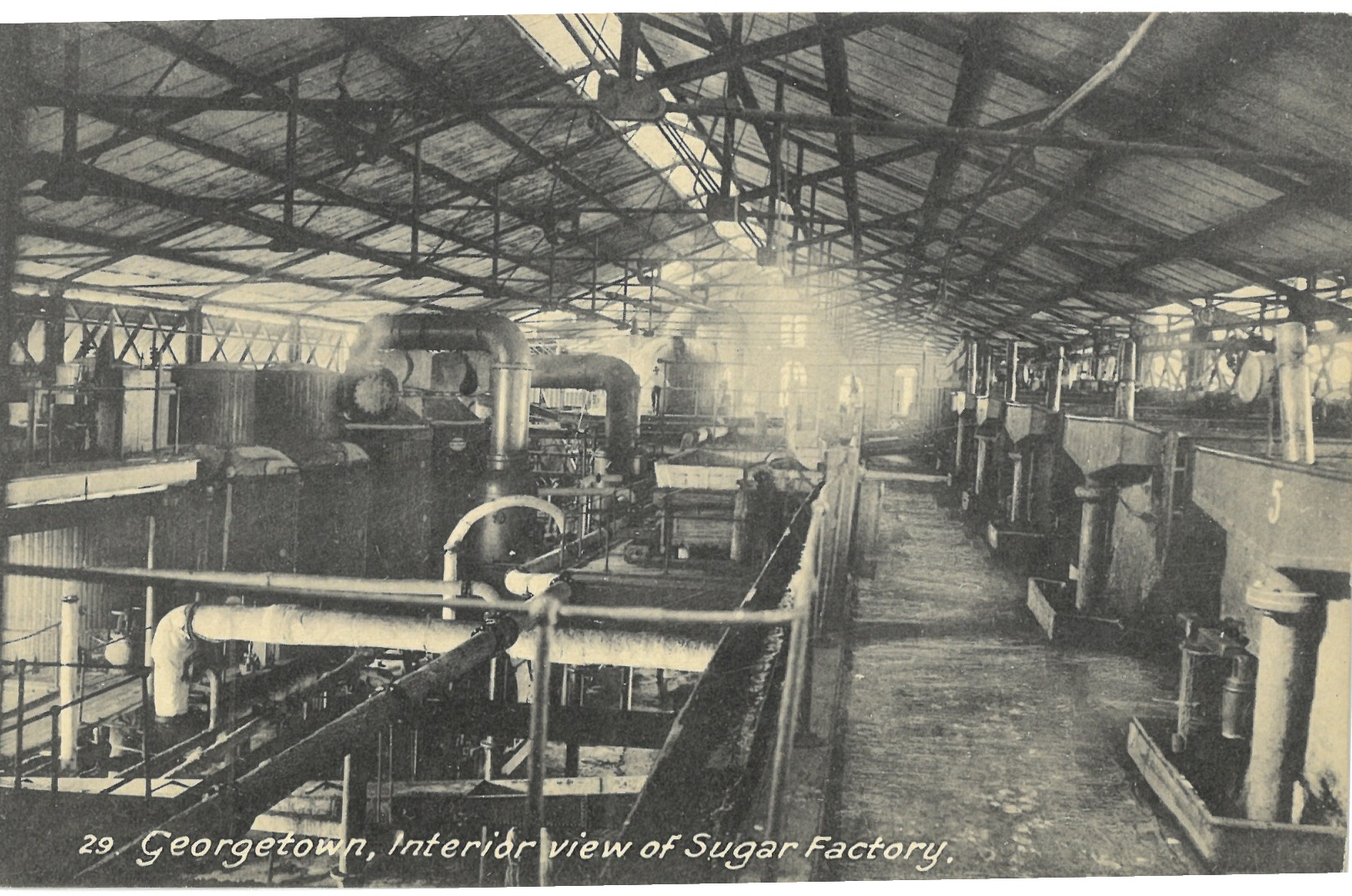
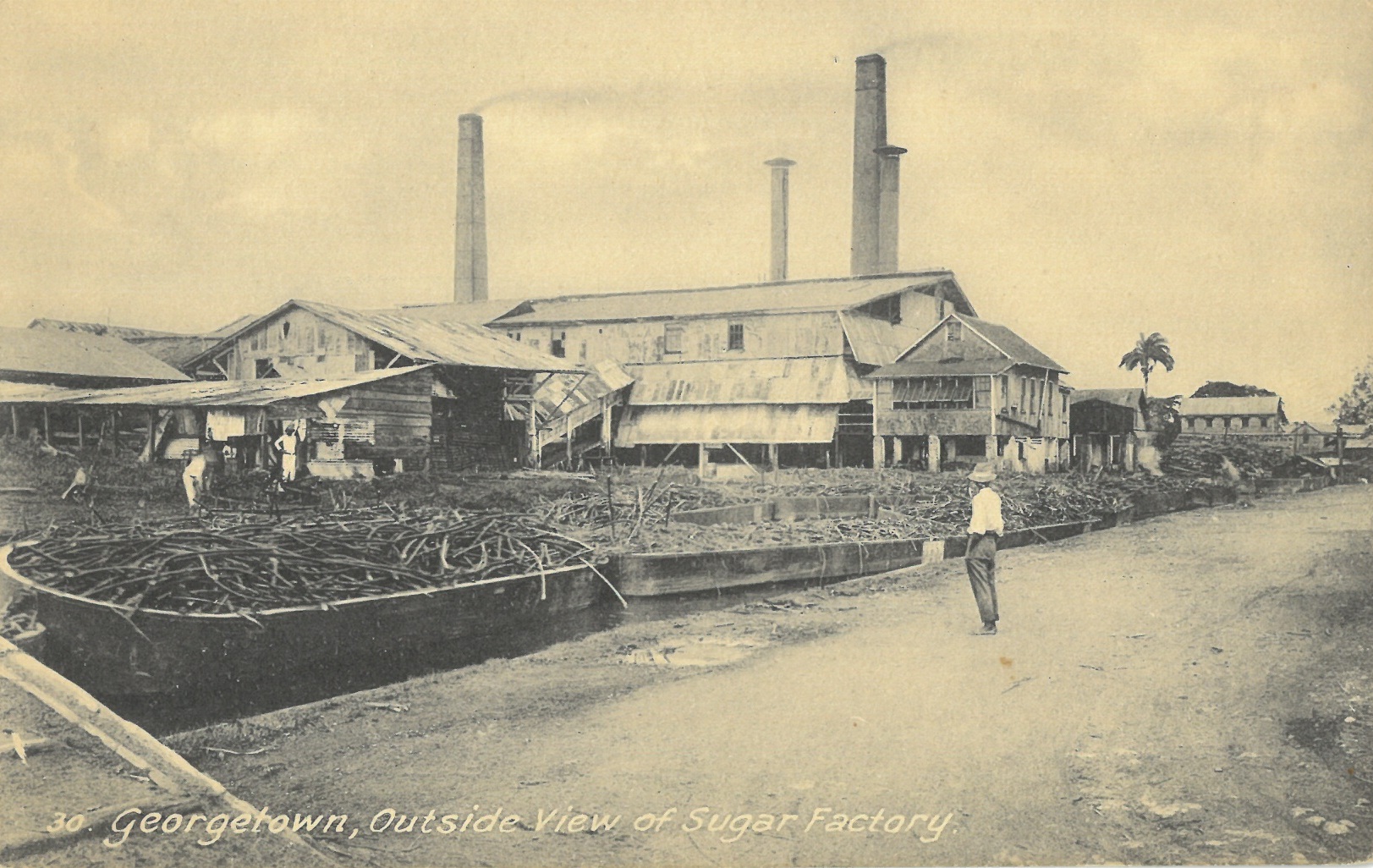
Given the paucity of surviving company records and the difficulties often experienced by those attempting archival research on the ground in Guyana, John Platt’s collection provides a coherent entry point, not only for Booker Bros but also for a wealth of related individuals, families and business interests. Cambridge University Library is extremely grateful to the donor for presenting this valuable research collection for scholarly use and for their support in cataloguing and making the collection accessible.
For enquiries, please contact: rcs@lib.cam.ac.uk.
[1] https://thebookerprizes.com/the-booker-brothers-and-enslavement
[2] Judy Slinn and Jennifer Tanburn, The Booker Story (Jarrolds, 2003).
[3] Catalogued as GBR/0115/RCS/RCMS 426: https://archivesearch.lib.cam.ac.uk/repositories/2/resources/17158.
[4] Catalogued as GBR/0115/RCS RCMS 426/4/2/3: https://archivesearch.lib.cam.ac.uk/repositories/2/archival_objects/2096798.
[5] Catalogued as GBR/0115/RCS/RCMS 426/1/6/5: https://archivesearch.lib.cam.ac.uk/repositories/2/archival_objects/2086210.
[6] For details of a claim on Plantation Leonora, see https://www.ucl.ac.uk/lbs/claim/view/8880.